
Psychiatric Case Formulations with Medication Management
We are experts in writing psychiatric case formulations with medication management for psychiatric evaluation templates for patient interviews that are consistent with the DSM-5-TR diagnosis and an evidence-based treatment plan. The case formulation is a continuous argument, transitioning from assessment to diagnosis, and finally to treatment.
What is Psychiatric Case Formulation?
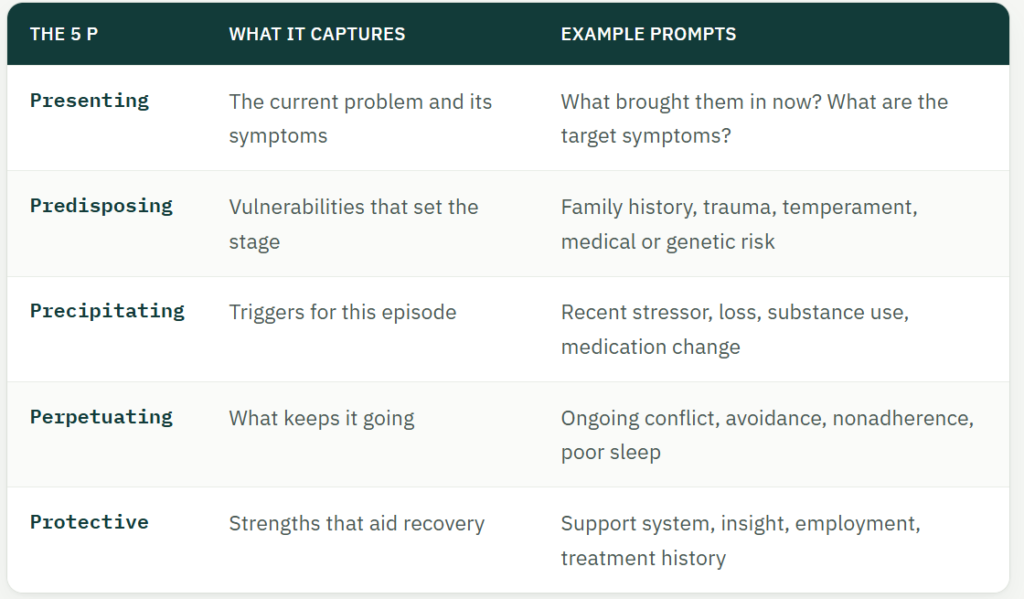
A case formulation is a structured argument that involves synthesizing the observed information with what you think is happening and what you plan to do. It is essential for the case formulations recorded on the psychiatric evaluation template for patient interviews to be accurate and complete. Each diagnosis should be based on the assessment data, and the treatment should have direct connectivity to both. A strong case formulation adheres to a chain of reasoning. The most useful approach to organizing the biopsychosocial data into a causal story is using the 5 Ps.
Biopsychosocial Data in the 5 Ps Format (Presenting, Predisposing, Precipitating, Perpetuating, Protective) for Psychiatric Case Formulations with Medication Management
Completing the Assessment Section of the Psychiatric Evaluation Template for Patient Interviews
In the psychiatric evaluation template for patient interviews for psychiatric case formulations with medication management, complete (a) identifying data and chief complaint, (b) history of present illness, (c) other biopsychosocial data. Identifying data involves writing a one-liner that contains the patient’s legal and preferred name, age, gender, pronouns, ethnic origin, referral source, and source of information. The chief complaint should be in the patient’s own words, in quotation marks.
The history of present illness section contains an explanation of the illness from onset to today. The focus is on mental and related physical manifestations; precipitating, aggravating, or modifying factors; duration and changes from previous levels of functioning; neurovegetative signs; safety (suicidal ideation, attempts, self-harm, or violence toward others); and pertinent negatives.
Other biopsychosocial databases include past psychiatric history; general medical history; substance use history; developmental, personal, and social history; family history; and review of systems. The past psychiatric history contains a discussion of prior diagnoses, therapy, medications with dose, duration, response, side effects, hospitalizations, higher levels of care, and past safety events. The general medical history contains an explanation of PCP, medical diagnoses, current medications, allergies, surgeries, pertinent labs, imaging, EKG, TBI, seizures, height, weight, BMI, LMP.
When explaining substance use history, that discussion is on substances, quantity, frequency, route, pattern, consequences, tolerance, or withdrawal, prior treatment, and relationship to the present illness. When explaining the developmental, personal, and social history, discuss birth and milestones, education and IEP, living situation, relationships and supports, gender identity and orientation, occupation and finance, military and legal history, spirituality, and trauma or abuse history. The focus in the family history section is psychiatric, medical, and genetic illness; substance use; and family suicide attempts and completions. In the review of systems, an explanation of head-to-toe symptoms not already captured in the HPI is included.
The mental status exam for psychiatric case formulations with medication management is your objective observation at the time of interview, which is different from the HPI that is historical. Document all domains, specifically sensorium, cognition, and orientation, appearance and behavior, motor activity, mood (patient’s own words should be quoted), affect, speech, thought process, content, perceptual disturbances, SI/HI, insight and judgment, attention and concentration, and recent/remote memory.
Filling the Diagnosis Section of the Psychiatric Evaluation Template for Patient Interviews
It is essential to ensure that the diagnosis is based on assessment data, while providing explicit evidence that the patient fulfills criteria and differentials.
Developing the diagnosis requires naming the primary diagnosis with its DSM-5-TM numeric code and specifiers, explaining the criteria met while citing the assessment data as evidence for each, listing differential diagnoses, and outlining substance use disorders.
Completing the Treatment and Medication Management Section of the Psychiatric Evaluation Template for Patient Interviews
The treatment section should contain a clear, evidence-based, and accurate psychotropic prescription supported by documented assessment data and the diagnosis, plus a follow-up plan.
It is essential to start with individualized, appropriate, achievable, and phased goals, which are measurable. The goals should target specific symptoms in the HPI, for instance, decreasing PHQ-9 scores from 18 to under 10 in eight weeks.
The medication decision for every psychotropic prescribed should have an explicit rationale. Here is the psychotropic medication decision rationale table:
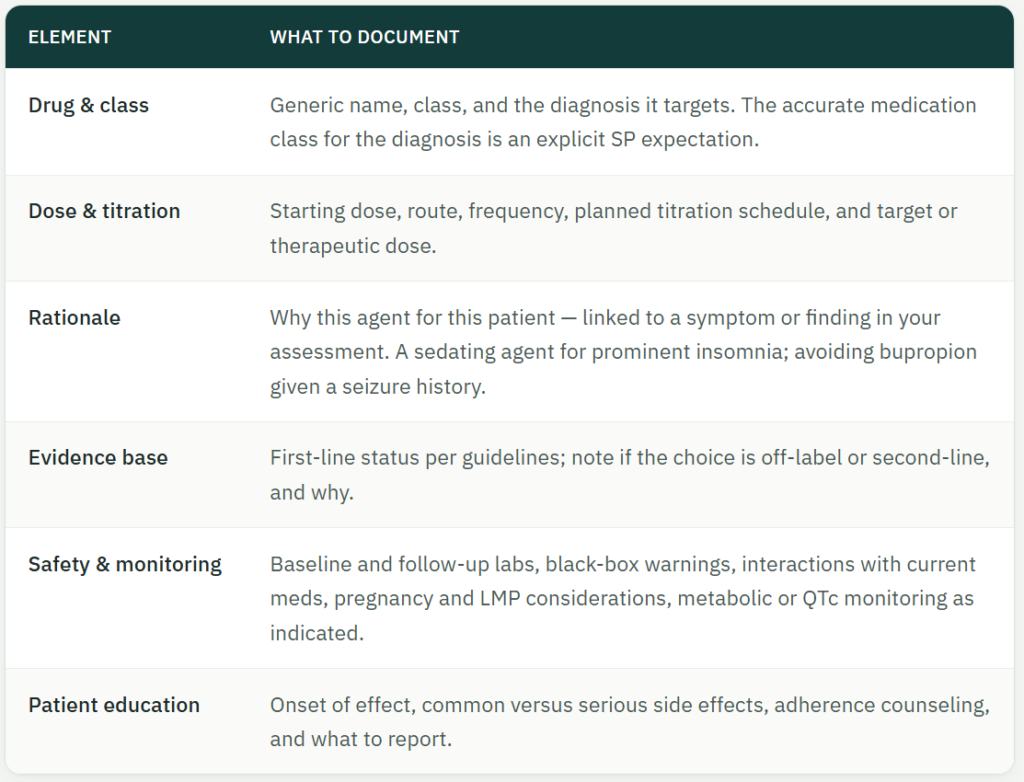
The rest of the plan includes developing non-pharmacologic care, labs and referrals, safety planning, and follow-up. Non-pharmacologic care can include CBT or DBT. Labs and referrals are baseline workup and referrals to specialists, including therapy. Safety planning, where SI / HI is present, documenting the plan and level-of-care decisions should be developed. Finally, explaining the follow-up is a prerequisite to reviewing treatment tolerability.
Get help with your psychiatric case formulations and medication management: We ensure adherence to the psychiatric evaluation template for patient interviews.
