
Mental Health SOAP Note Writing
Mental health SOAP note example by professionals who understand how to accurately describe subjective, objective, assessment, and plan components.
What a SOAP Note Looks Like in Mental Health
A SOAP note is used to structure a therapy session into four parts [Subjective, Objective, Assessment, and Plan] so the record is concise, defensible, and useful.
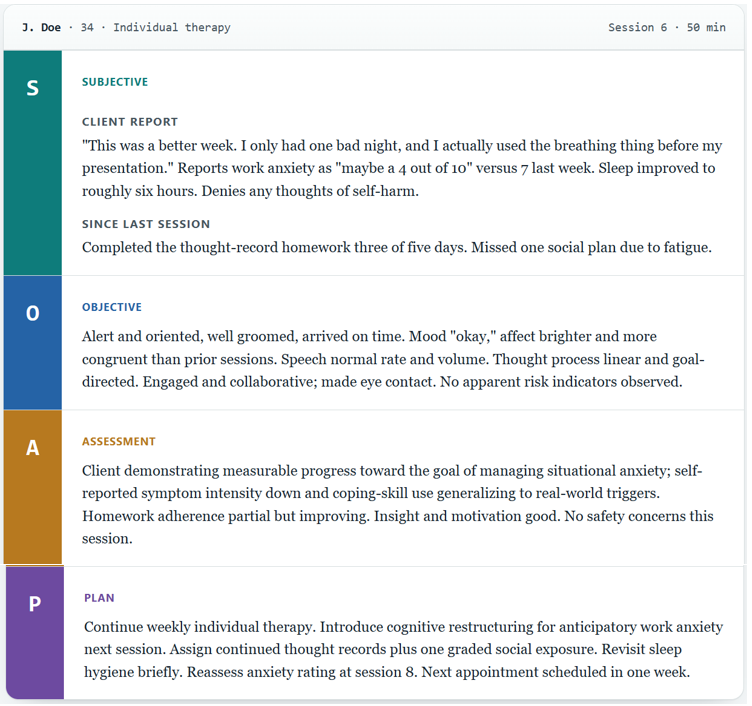
- Subjective contains the client’s report and stated concerns. The content includes symptoms, experiences, and self-reported changes since the last session.
- Objective has the observations of mental status and behavior. In particular, the mental status exam findings, appearance, behavior, and standardized scores like PHQ-P or GAD-7.
- Assessment contains the clinical impression and progress toward goals. In this section, the S and O connect.
- Plan has the interventions, homework, referral actions, and outlines for the next session.
The SOAP note allows healthcare professionals to document patient information in a structured and organized format. The structured approach reminds clinicians of specific actions while providing a framework for assessing information. As a cognitive framework, the SOAP note supports clinical reasoning to evaluate, diagnose, and treat patients based on the information provided. Our experts can help you create SOAP notes that provide essential information about a patient’s health status and facilitate communication among healthcare professionals. We understand that a SOAP note, when done well, captures a session’s clinical reality, supports medical necessity for payers, and holds up during an audit.
Psychiatric SOAP Note Example
Writing a Mental Health SOAP Note
When writing a SOAP note for psychiatry, it is essential to:
- Keep subjective and objective genuinely separate: What the client says is in Subjective. What you observe, such as affect, behavior, and mental status, is Objective. When writing your SOAP note, our experts ensure you keep them separate.
- Tie every note to the treatment plan: The assessment should show progress (or lack of it) towards a specific goal.
- Documenting the risk at every session is essential even when it’s negative. The absence of documentation can be perceived as a missing assessment.
- In the subjective section, record the client’s own account, using direct quotes for clinically significant statements and summarize the rest.
- The objective section requires recording observable and measurable data, which can be done using standardized instruments.
- After interpreting S and O, the assessment should contain a justification for treatment.
- Ensure the plan has concrete next steps.
SOAP Vs. DAP and BIRP
SOAP is the default format used in most therapy and psychiatric settings to support clinical reasoning by splitting the subjective and objective. Conversely, there are DAP and BIRP. DAP (Data, Assessment, Plan) merges subjective and objective into one “Data” section and is more appropriate for briefer sessions. BIRP (Behavioral, Intervention, Response, Plan) is more commonly applied in case management.
Get a SOAP note from our professional experts, who understand how to organize the information predictably.
