
GCU PICOT-D Question for DPI Project
GCU PICOT-D Question for DPI project is offered by research writing experts who understand the literature evaluation table. Elaboratively, we understand that the PICOT-D question is among the most important statements you will write in your DNP program. An approved PICOT-D provides the foundation and anchor for your literature evaluation table and Direct Practice Improvement (DPI) Project.
Getting an approved PICOT-D can be challenging, especially finding the primary articles that fulfill the criteria for acceptable research and literature evaluation table guidance. This is why we offer PICOT-D writing help, where our goal is to comply with the GCU DNP PICOT-D Original Research Checklist and accurately complete the PICOT-D question template.
PICOT-D Question for DPI project
You might be wondering: What even is a PICOT-D? Well, a PICOT-D question is a structured, evidence-based clinical question used in the GCU’s DNP program to define the focus of a DPI Project. A GCU PICOT-D Question extends the traditional PICOT format: Population, Intervention, Comparison, Outcome, Time, by adding a D element, which refers to the Data: The source your measurable outcome data will actually come from.
In essence, PICOT supports the development of a focused clinical question, and the D requires thinking of how you will prove the intervention works.
The GCU DPI project is grounded in quality improvement. This means that your practice problem must originate from your project site and be backed by current site data, indicating the need. Once you identify possible practice issues at your site, we then proceed to conduct a detailed literature search to ensure that the intervention identified is evidence-based.
A GCU DPI project can either involve translating original research or implementing clinical practice guidelines (CPG). The aim of a DNP project is not inventing an intervention or creating new knowledge; the focus is translating proven evidence into practice to achieve a specific and measurable patient outcome.
What does the D in the PICOT-D Stand for?
D stands for data, and it requires answering: Where will the data for your measurable outcome come from?
GCU PICOT-D Template
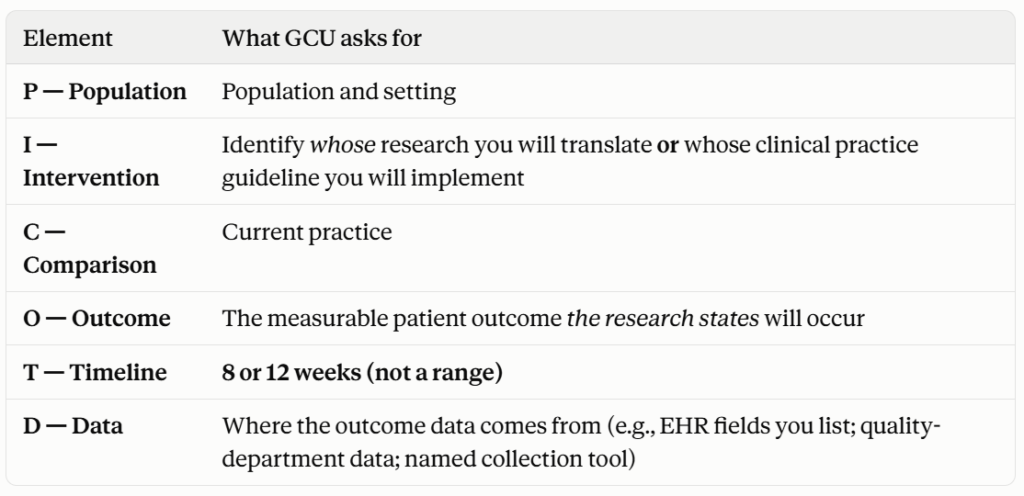
Get help from experts who can accurately complete the GCU PICOT-D question template. We will collaborate to come up with the most concise PICOT-D.
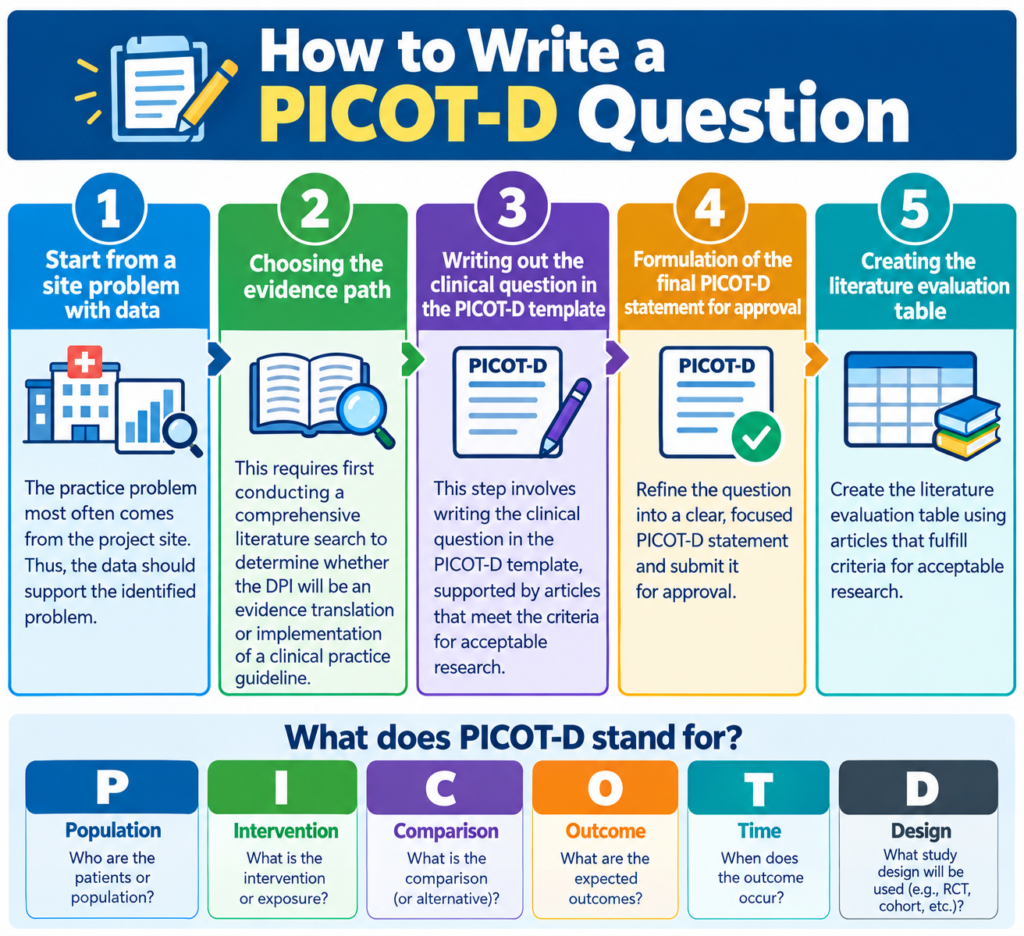
How to Write a PICOT-D Question
- Start from a site problem with data: The practice problem most often comes from the project site. Thus, the data should support the identified problem.
- Choosing the evidence path. This requires first conducting a comprehensive literature search to determine whether the DPI will be an evidence translation or implementation of a clinical practice guideline.
- Writing out the clinical question in the PICOT-D template, supported by articles that meet the criteria for acceptable research.
- Formulation of the final PICOT-D statement for approval
- Creating the literature evaluation table using articles that fulfill criteria for acceptable research.
The PICOT-D and the availability of published literature that fulfill criteria for acceptable research require a comprehensive search of electronic databases. Getting a PICOT-D approved can be challenging, especially when it comes to matching the population, intervention, comparison, outcomes, time, and data that have been done in the published literature.
The chosen intervention for translation or clinical practice guidelines should be supported by original quantitative primary articles that are current and have a statistically significant p-value. It is essential to ensure that an intervention is supported by at least 15 articles. Our research writers ensure that GCU’s PICOT-D selection guidelines are adhered to obtain approval with minimal revisions.
PICOT-D Examples
Here are two PICOT-D Question topics that can be explored and guide the literature search:
PICOT-D Example One
Among adult patients in a primary care clinic, will translating Coronado et al.’s research on implementing mailed fecal immunochemical test compared to current practice impact colorectal cancer screening in eight weeks?
PICOT-D Primary Article One
Coronado, G. D., Petrik, A. F., Vollmer, W. M., Taplin, S. H., Keast, E. M., Fields, S., & Green, B. B. (2018). Effectiveness of a mailed colorectal cancer screening outreach program in community health clinics: The STOP CRC cluster randomized clinical trial. JAMA Internal Medicine, 178(9), 1174–1181
PICOT-D Example Two
In adults with hypertension in an outpatient clinic, will translating Sangouni et al.’s dietary approaches to stop hypertension (DASH) diet, compared to current practice, decrease systolic and diastolic blood pressure over 12 weeks?
PICOT-D Primary Article One
Sangouni, A. A., Hosseinzadeh, M., & Parastouei, K. (2024). The effect of dietary approaches to stop hypertension (DASH) diet on fatty liver and cardiovascular risk factors in subjects with metabolic syndrome: a randomized controlled trial. BMC Endocrine Disorders, 24(1), 1-12.
The above PICOT-D nursing question examples can guide you in the formulation of a clinical question. Notably, we can offer you personalized support, where we collaboratively create a GCU PICOT-D Question that is relevant to your practice site and can be approved. Contact us today!
