
Evidence Table Writing
Our Evidence table writing is offered by experts in nursing research. Alternative names for the evidence table are the table of evidence, evidence summary table, evidence matrix table, evidence synthesis table, evidence evaluation, and evidence synthesis table. In this webpage, we will use the names interchangeably.
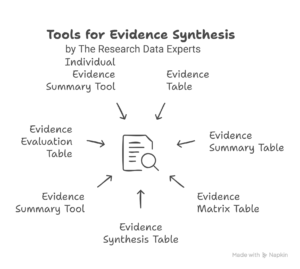 The evidence table is essential in the literature synthesis process because it provides a summary of each study’s core components. Filling an evidence table assists nursing researchers in appraising the articles that support the intervention to be implemented. The table of evidence is also essential when conducting a literature review. We offer assistance with an evidence table for literature review in nursing, whether for nursing research, a DNP quality improvement project, or a systematic review. The table of evidence in nursing research provides readers with an overview of the studies to be synthesized. In a quality improvement project, our DNP writers create a table of evidence in APA format. We offer exceptional evidence table writing, contact us today
The commonly used evidence table templates in nursing are:
- Johns Hopkins’ individual evidence summary tool
- Melnyk and Overholt’s evidence table or evaluation table template
The John Hopkins Individual Evidence Summary Tool
The 11 components of the individual evidence summary tool are
- Reviewer name(s): We record the name(s) of the person reviewing each article. If the evidence summary is for a DNP project, then the review’s name will be that of the DNP student. If the table of evidence is for a systematic review, then the reviewers’ names will be those of the authors assigned the role of performing the literature search.
- Article number: Our individual evidence summary tool writers assign each article a number.
- Author, date, and title: The evidence summary table writers will format the author and date in APA, followed by the article’s titles.
- Type of evidence: The evidence matrix table writer will indicate whether the article is quantitative, qualitative, or a mixed method. Then specify the design, which can be a randomized controlled trial, quasi-experimental, case study, meta-analysis, systematic review, etc.
- Population, size, and setting: The evidence synthesis table writer will assess each article to outline the population, number of participants, and study location or care setting.
- Intervention: Our evidence evaluation table writers will identify the intervention(s) discussed in the articles, which should be related to the intervention or comparison component of your PICOT question.
- Finding that helps answer the evidence-based practice question: The individual evidence summary tool writer will identify the findings in each article to directly answer the evidence-based practice question. The findings support the relevance of the intervention in being used to promote practice change in the project setting.
- Measures used: The evidence table writer will outline the measures or instruments the authors used in collecting data. The measures can be surveys, validated tools, subscales, or questionnaires. The measures assist in informing about the tools that can be used in data collection when the EBP is implemented.
- Limitations: The table of evidence will include the limitations of the evidence listed by the authors and those identified based on their professional knowledge after assessing the methodology, quality of reporting, and generalizability of findings.
- Evidence level and quality: Our evidence matrix table writers will use evidence appraisal tools to determine the evidence and quality of the articles. The evidence level can be (I-V), and the quality can be either (A, B, or C).
- Notes to team: The section is used by our evidence summary tool writers to include any useful information in the EBP process that has not been captured anywhere else in the evidence matrix table.
Get help with your individual evidence summary tool. We will ensure that your summary table of evidence is detailed and relevant to your evidence-based practice question. Save time with our evidence table writing.
Melnyk and Overholt Evidence Table | Evaluation Table Template
The Melnyk and Overholt evaluation table template contains 10 sections:
- Citation: Author, date of publication, & title: This section of the table of evidence in research contains the author(s), date of publication, and title of each article identified as suitable in informing the literature synthesis.
- Purpose of study: The table of evidence writer in the section will include the purpose outlined by the researchers in the article in the designation section of the table. We ensure that the purpose of the article is consistent with the project focus.
- Conceptual framework: Not all researchers include a conceptual framework. Hence, our evidence summary table writers will review each article to determine whether it was applied.
- Design/method: Our evidence matrix table writers will identify the method and design used in the identified article.
- Sample/setting: Our evidence synthesis table writers include the sample of participants and the setting where the study was conducted.
- Major variables studied and their definitions: In the evidence summary tool, our writers will identify the independent and dependent variables in the study and provide a definition as outlined by the researchers.
- Measurement of variables: Our evidence evaluation table our writers will outline the instruments or tools that researchers used in collecting data.
- Data analysis: The section contains a discussion of the statistical or thematic analysis performed by researchers.
- Study findings: Our writers will outline the results that inform the study
- Worth practicing, level of evidence, strengths, weaknesses, feasibility, conclusion, and recommendation.
There are different evidence matrix table templates. We request that you provide us with the evidence table format you prefer our experts to use. If you do not have a preferred table of evidence template, our standard practice is to use Johns Hopkins’ individual evidence summary tool. Building an evidence table is simple with our help. Whether it is a table of evidence for systematic review, to evidence table for literature review, to evidence table for research, or to matrix table for a DNP project, we have the expertise to fulfill your needs. Our evidence table generator experts can provide the services and solutions you need. Get our evidence table writing today and experience exceptional professionalism.
