
DNP Project Charter Proposal Writing Service
Offering DNP project charter writing services to ensure that you fulfill your doctoral project charter proposal checklist. After receiving your DNP topic completed and approved, the next stage is to develop a doctoral project charter proposal. We specialize in providing DNP writing services, meaning that we understand that an effectively filled project charter is essential to obtain approval and proceed to the next phase of submitting to the IRB. In this webpage, we explain how we fill the specific component of the DNP project charter proposal so that you understand the quality you expect from our DNP writers. The content on this webpage also provides you with guidance on how to fill out a DNP project charter proposal.
Components of a DNP Project Charter Proposal
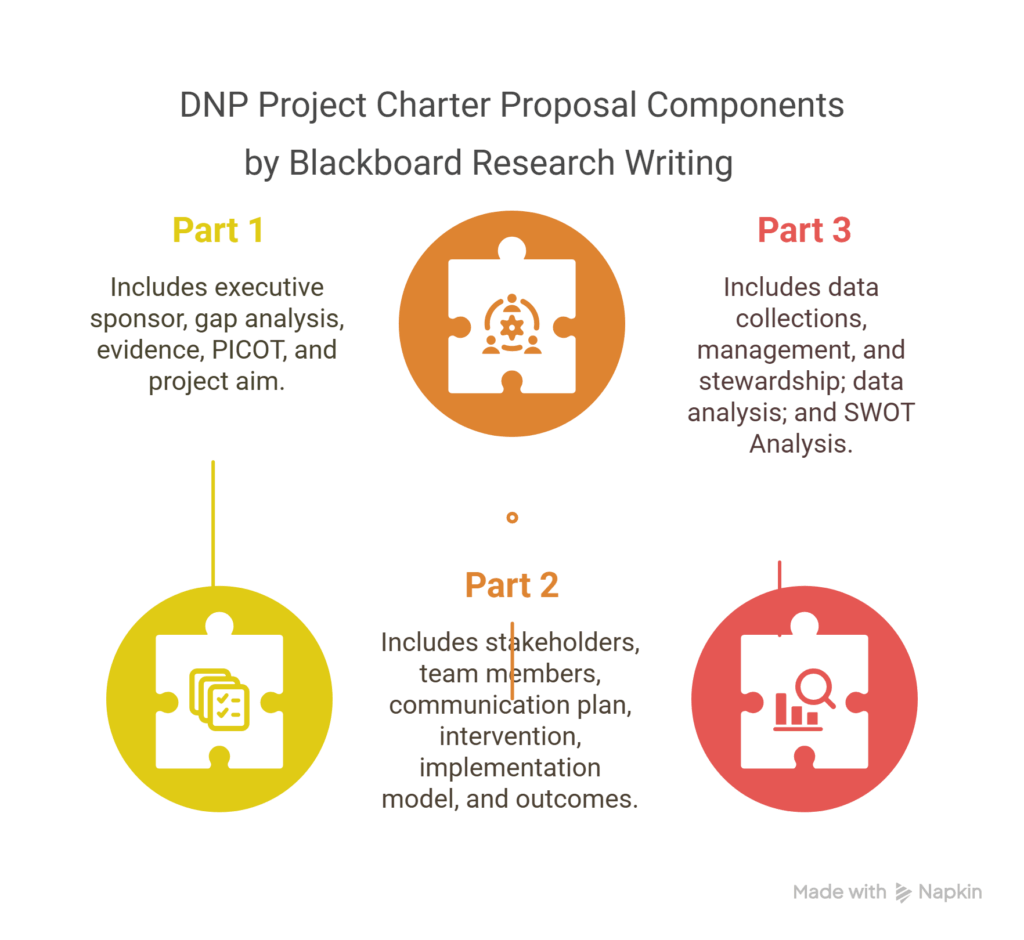 Part 1 of the DNP Project Charter Proposal
Filling in the project name, project site, contact at the clinical site, and preceptor’s information are straightforward components of the charter proposal. The next sections that should be completed are the executive sponsor, gap analysis, evidence to support the need, PICOT, and project aim.
In the executive sponsor section, the focus is on providing the rationale for the person you chose to fill this position in your project charter. Our DNP project charter writers ensure to provide rationales on why the executive sponsor’ experiences, competencies, and skills that support their suitability as executive sponsors for your evidence-based change.
The gap analysis should contain a discussion on the current gap at the national, state, and practice setting levels. Our doctoral writers ensure that when writing the project gap section, the content is supported by data from credible organizations such as the National Database of Nursing Quality Indicators, the CDC, and project setting internal data. We then develop a fishbone diagram and include it as an appendix to support in explaining the gap in practice and its possible environments, nurse-related, or patient-related factors.
In the evidence to support the need section, our DNP project charter writers use empirical literature to explain the importance of addressing the identified gap and outline possible evidence-based interventions that can be used to address the problem.
The PICOT section contains the clinical question. Our project charter writers begin the section by outlining the current practice, then provide the clinical question in the PICOT format.
In the project aim section, the writers will outline the project’s primary and secondary aims in a concise paragraph. The aims will be directly related to the topic and PICOT.
Part 2 of the Doctoral Project Charter Proposal
The second part of the DNP project charter proposal contains a discussion on stakeholders, team members, communication plan, intervention and measurement, implementation model/framework, and proposed outcomes. The stakeholders, team members, and communication plan contain an overview of who will be involved in ensuring the successful implementation of the project, their role, impact, and contributions. Creating a communication plan for the stakeholders and project team is essential because it ensures that all the relevant individuals will be involved in the project, prompting intervention, fidelity, and sustainability.
The intervention and measurement section contains a description of the changes you are proposing. Here, our DNP project charter proposal writers will explain your intervention using empirical literature and attach it as an appendix. We will also synthesize literature on the intervention, supporting that it is evidence-based. Subsequently, our DNP project charter writes discuss the intervention’s operational logistics, providing a step-by-step outline on how implementation will occur. We also include a timeline or Gantt chart containing the activities to be conducted.
The implementation models/framework should contain a discussion of the theory or model that will guide the practice change. An example of the framework that our experts can use is the PDSA.
In the proposed outcomes section, the focus is usually on the metric, outcome measure, process measure, and balancing measure. Our DNP project charter proposal writers ensure that the proposed outcomes align with the topic, project aim, and PICOT.
Part 3 of the DNP Project Charter Template
The final part of the DNP project charter proposal template contains the plan for data collection, management, and stewardship; data analysis; and SWOT analysis. Our DNP project writers in the data collection, management, and stewardship describe the data to be collected, the person who will collect the data, when it will be collected, how it will be stored, protection, and the manner diversity, equity, and inclusion will be upheld. A comprehensive discussion will be essential in obtaining IRB approval. Your assigned DNP project charter will ensure to include the appropriate data collection tools in the appendix, ensuring that the section is comprehensive.
In the data analysis section, our DNP research writers outline the quality improvement design that will be applied and how descriptive statistics will be performed to analyze the collected data.
The SWOT analysis involves determining the strengths that will promote the project implementation at the clinical site, the weaknesses that might be barriers to intervention adoption, opportunities that could emerge because of the practice change, and threats that could compromise the quality improvement’s feasibility and sustainability.
Get a comprehensive DNP project charter proposal. Our writing services are tailored to your needs, specifically fulfilling the doctoral project charter proposal checklist.
