
DNP Practicum Readiness Form
DNP practicum readiness form by experts to help you define the practice site, problem, PICOT question, and project plan. Before beginning to fill out the practicum readiness form, it is essential to have a discussion with your preceptor, mentor, and site decision-maker about the identified practice problem and intended evidence-based intervention. It is essential for you to have obtained an approved practicum site, where you will implement the project, which results in receiving a letter of support. The letter of support should contain the site’s official letterhead, be signed by the key decision-maker, outline the project’s scope, and state whether the setting requires IRB approval. On this page, we focus on all sections of the DNP practicum readiness form, discussing what each should contain and how we can help with our research data expertise.
Section One of the Practicum Readiness Form
The section should contain your (a) your identifying details (full name, student ID, email, phone with area code, and physical address), (b) attestation, (c) working title in eight to 10 words, with keywords relating to the intervention and practice problem, (d) name of the practicum site, (e) practicum team information (contact person, preceptor, mentor, and key decision-maker), (f) summary of the problem based on the site’s context, (g) status of the letter of support, and (h) translation science model, which can be KTA, RE-AIM, i-PARiHS, ACE Star, Lewin’s, Kotter’s. Iowa Model, JHEBP, or Rogers’ Diffusion.
Writing the Problem Statement in the Practicum Readiness Form
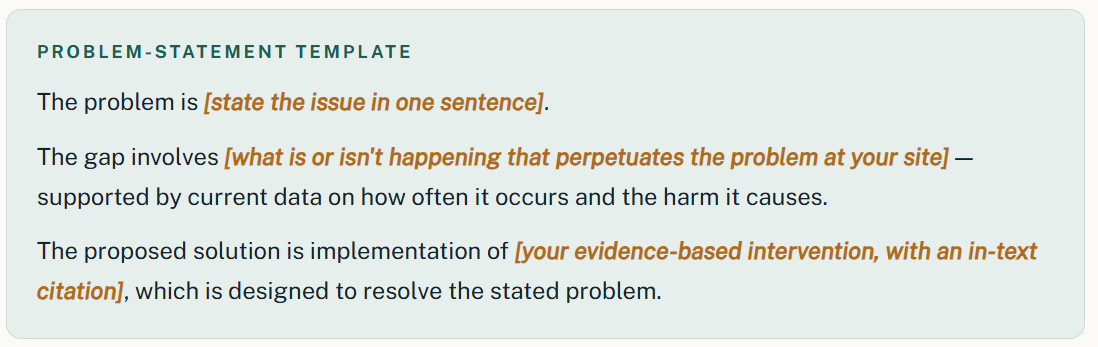
In this section, it is essential to explicitly state the problem, the gap, and the proposed solution in five to six sentences. When developing your problem statement, we ensure that the intervention is consistent with your practice problem. For instance, if the practice problem is uncontrolled hypertension, then the intervention can be something such as the DASH Diet. Below is the template we use:
Completing the Purpose Statement in the Practicum Readiness Form
The purpose statement should be a one-line sentence outlining the expected outcome and the evidence-based intervention that will result in the change. The template is: The purpose of the proposed DNP Project is to achieve_______(desired outcome) by implementing______________( evidence-based intervention).
PICOT Question in a DNP Practicum Readiness Form
A PICOT question should contain the population, intervention, comparison, outcome, and time. Here is the PICOT template: In __(population) how does ____(intervention) compared with__(comparison) affect____(outcome) within _____ (time). See our PICOT questions discussion. When developing your PICOT question, we ensure that the population is neither student nor faculty, the site is not an educational institution, the intervention is not education or compliance only, the intervention has an explicit name, the timeline ranges from 10 to 14 weeks, and does not contain any remote project. Of importance, we avoid using words such as “prevent” or “research.” In the population, sample, and criteria, the rules we adhere to are that criteria do not lean on social determinants, such as requiring participants to speak English, own a phone, have internet access, or be able to transport themselves to the clinic.
Section Two of the Practicum Readiness Form: The Project Plan
We include at least five APA-formatted recent research articles, two supporting the practice problem, and three on the evidence-based intervention. Subsequently, our evidence-based experts define the intervention timeline, providing a week-by-week plan, explaining the feasibility and barriers, outlining the data collection and outcomes, specifying the data analysis, and stating the permission and site IRB. In the data collection, it is essential to have permission to use a validated or reliable tool if one is needed in your evidence-based intervention.
Get your DNP practicum readiness form completed by experts who understand each section’s requirements. Our goal is to ensure that your practicum readiness form provides the foundation for your proposed quality improvement project.