
DNP Capstone Project Help
DNP Capstone Project Help by DNP capstone project writers who understand topic selection, PICOT, literature review, data analysis, and reporting.
What is the DNP Capstone Project?
A DNP capstone project is the final scholarly output of a Doctor of Nursing Practice program. In a DNP project, the focus is on identifying a real problem in a practice setting, applying existing evidence, implementing a change, and measuring the results.
A DNP capstone project is referred to by different names:
- DNP project is the term the AACN uses
- DNP scholarly project is a common phrase used in program handbooks
- DNP capstone project is an older term
- Doctoral project or practice inquiry project is also another common name
All these names mean the same thing. In this article, we explain the DNP capstone project help provided by our experts, from practice problem identification to dissemination.
Purpose of Our DNP Capstone Project Help
We provide human writing (No AI), editing, paraphrasing, revision, and consultation DNP capstone project help to help you translate evidence into practice. The goal of a DNP capstone project is to improve practice or outcomes in a specific setting.
Typical methods of a DNP project are quality improvement, evidence-based practice change, and program evaluation. Settings of DNP capstone projects include clinics, units, health systems, or the community.
Quality improvement DNP capstone projects are conducted to test a change to a care process and track a measure over time.
Evidence-based practice changes to DNP projects involve translating a clinical guideline or proven intervention into routine care.
While less common, program development and evaluation DNP capstone projects are used to design a new service and assess its results.
The final products you will get from our expert capstone project writers are a project paper or manuscript, publication manuscript, PowerPoint presentation, and/or tri-fold poster.
Core Requirements of a DNP Capstone Project
We understand that your DNP capstone project should be consistent with AACN’s standards, be evidence-based, relevant to your practice setting, and have IRB approval under the quality improvement determination, rather than human-subject research.
Stages of a DNP Project
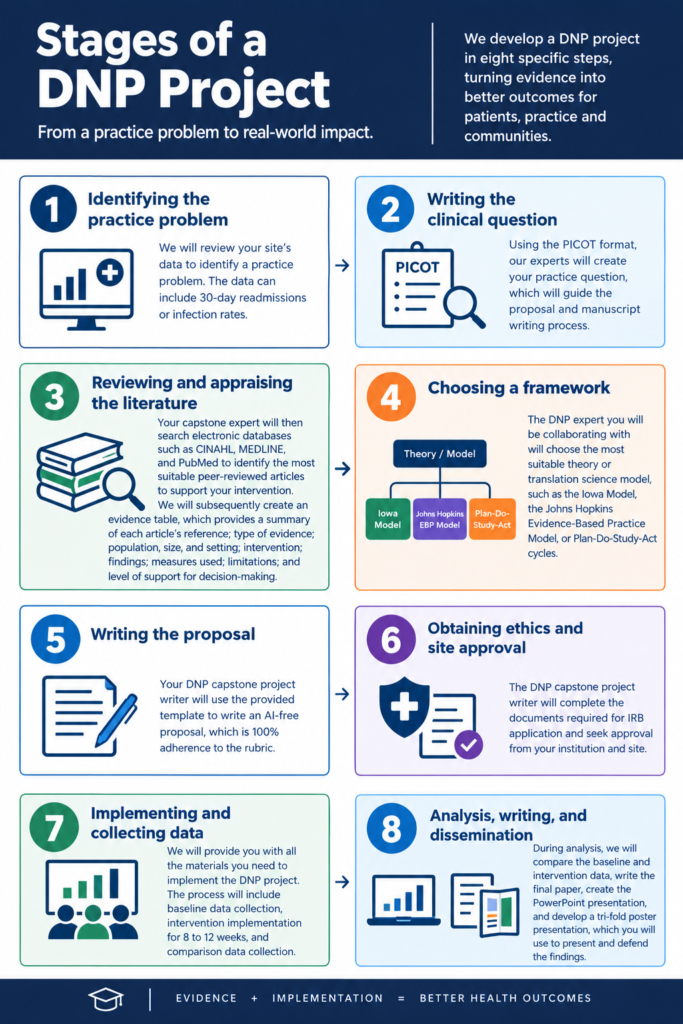
We develop a DNP project in eight specific steps, namely:
Identifying the practice problem
We will review your site’s data to identify a practice problem. The data can include 30-day readmissions or infection rates.
Writing the clinical question
Using the PICOT format, our experts will create your practice question, which will guide the proposal and manuscript writing process.
Reviewing and appraising the literature
Your capstone expert will then search electronic databases such as CINAHL, MEDLINE, and PubMed to identify the most suitable peer-reviewed articles to support your intervention. We will subsequently create an evidence table, which provides a summary of each article’s reference; type of evidence; population, size, and setting; intervention; findings that help answer the EBP question; measures used; limitations; and level of support for decision-making.
Choosing a framework
The DNP expert you will be collaborating with will choose the most suitable theory or translation science model, such as the Iowa Model, the Johns Hopkins Evidence-Based Practice Model, or Plan-Do-Study-Act cycles.
Writing the proposal
Your DNP capstone project writer will use the provided template to write an AI-free proposal, which is 100% adherence to the rubric.
Obtaining ethics and site approval
The DNP capstone project writer will complete the documents required for IRB application and seek approval from your institution and site.
Implementing and collecting data
We will provide you with all the materials you need to implement the DNP project. The process will include baseline data collection, intervention implementation for 8 to 12 weeks, and comparison data collection.
Analysis, writing, and dissemination
During analysis, we will compare the baseline and intervention data, write the final paper, create the PowerPoint presentation, and develop a tri-fold poster presentation, which you will use to present and defend the findings.
Structure of a DNP Capstone Project
| Section | What it covers |
| Title page and abstract | A structured summary of the problem, methods, results, and conclusions |
| Introduction | Background, local problem, significance, and purpose statement |
| Clinical question | The PICOT question and project aims |
| Literature review | Search strategy, evidence synthesis and evidence table |
| Framework | The theory or model guiding the change. |
| Methods | Setting, participants, intervention, measures, data collection, ethics |
| Results | Findings with tables and charts |
| Discussion | Interpretation, limitations, cost and sustainability |
| Implications | What the findings mean for practice, policy, and education |
| Conclusion | The main result and next steps |
| References and appendices | Sources, tools, approval letters, data collection forms |
Get DNP capstone project help to apply evidence to a real practice problem.
